
Modern Patio Ideas: Stylish Outdoor Designs to Elevate Your Living Space
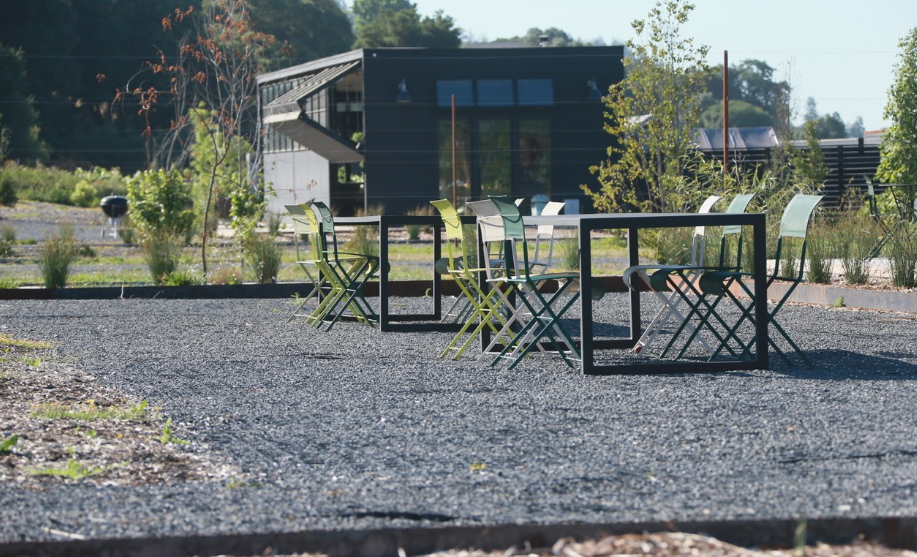
The best modern patio ideas combine crisp geometry, effective drainage, and materials that last through weather extremes and the weight of furniture and guests. Designers no longer treat the patio as decoration, they build it as a structure that anchors the space. The emphasis is on clean lines, neutral tones, and continuity with the home’s interior palette, whether the finish is gravel, concrete, or permeable grid.
Defining Modern Patio Design
Modern patio design ideas begin with proportion. The layout depends on the relationship between the:
- Home façade
- Grade changes
- Movement patterns
Simple, structured lines create order, while mixed materials add visual rhythm. A patio framed with steel edging and filled with gravel or stone slabs stays low-maintenance and keeps water moving through the surface instead of pooling.
Material Choices & Colour Palette for Modern Patios
Every modern patio starts with materials that balance structure, drainage, and visual consistency. The right combination determines not only how the surface performs but also how it ties into the surrounding architecture.
Permeable vs. Solid Surfaces
Material selection defines both appearance and long-term behavior. Smooth concrete and large-format pavers give a monolithic look but can trap water without slope or expansion joints. Permeable paving systems, such as TRUEGRID® pavers, fit right into the modern design language.
- Their open-cell grid supports gravel, crushed stone, or grass infill while maintaining rigidity under vehicles or heavy furniture.
- Rain drains vertically through the base layers, removing the need for visible drains (or crowning, or sloping) and matching the minimalist goal of multi-function design.
TRUEGRID’s modular grid mirrors the geometry used in many backyard paving ideas designed for efficient drainage and clean architectural lines.
Colour and Texture Coordination
Color and texture define the personality of a modern patio. Pale limestone or light-tone gravel keeps temperatures lower underfoot, while charcoal or black steel edging adds crisp contrast. Neutral hues pair easily with concrete planters, outdoor kitchens, or wood accents. Matching tones between the patio surface and façade creates a calm, integrated composition.
Installation & Performance Metrics
Performance starts beneath the surface.
- TRUEGRID patio systems typically use 2-4 inches of compacted angular stone base to distribute weight and promote infiltration. For light use and stable soils, a TRUEGRID patio may not need any base and can go directly on the prepared existing soil.
- When properly installed, the surface handles heavy foot traffic or vehicle loads (with a base layer).
- Infiltration rates typically exceed any rainstorm event and stormwater requirements.
- That structure eliminates puddling, reduces runoff, and extends the life of adjacent landscaping.
Maintenance is minimal and generally limited to removing surface debris such as leaves. Isolated refilling of stone, while not common, should be done when needed.
Small Modern Patio Ideas
Even tight yards gain breathing room with layered elevations. A single step or floating platform separates lounge and dining zones without walls. TRUEGRID’s lightweight grid sits directly on prepared base rock, reducing excavation and speeding installation. Filled with angular gravel, the surface locks tight against shifting or ruts.
Many small modern patio ideas rely on this optical trick, light tones reflect daylight while repeating grid patterns draw the eye outward. Vertical accents such as wall planters or slatted screens increase height perception and privacy without enclosing the space.
Lighting, Planting and Furnishing
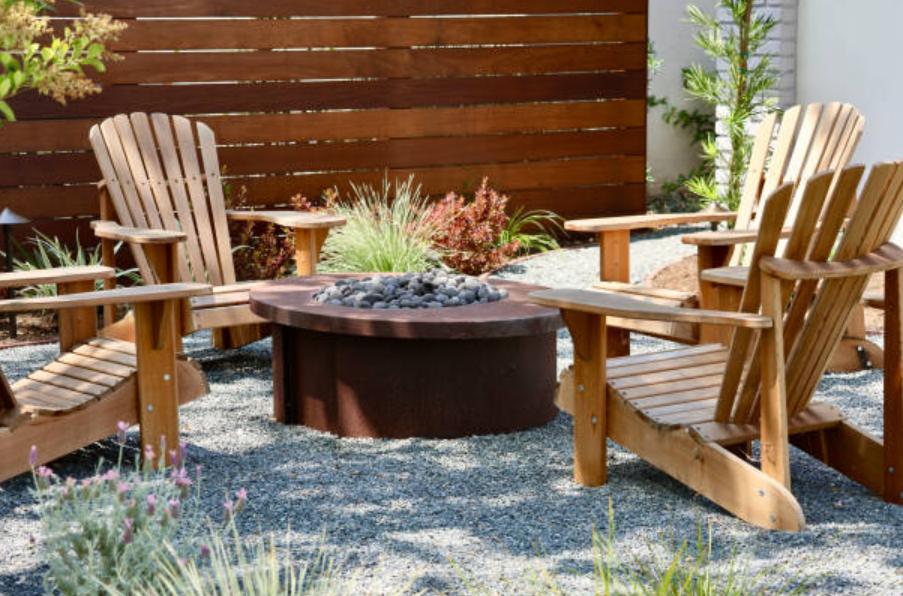
Modern patios rely on subtle design moves that define zones without walls. Light, vegetation, and furniture each reinforce geometry and movement across the space.
Lighting Design
Lighting finishes the look once daylight fades. Still, geometry guides the composition. Linear LED strips recessed along edges trace the form without visible hardware. Down-lights and in-ground fixtures pick out the contrast between gravel, stone, and planting beds.
Planting Structure
Plantings follow modern restraint: ornamental grasses, succulents, and low shrubs accent geometry instead of hiding it. Raised planters built from steel or concrete double as seating walls. Because permeable pavers handle runoff, irrigation zones stay balanced and soil remains firm.
Furniture Layout
Furniture maintains the same precision. Low-profile modular seating and cantilevered tables mirror the patio’s horizontal rhythm. When furniture footprints align with the paver layout, visual continuity strengthens the composition.
These balanced compositions showcase the geometry and restraint that define today’s modern patio ideas, linking aesthetic simplicity with practical outdoor living.
Sustainable and Permeable Performance
After form and lighting come the environmental considerations. Sustainability shapes nearly every modern backyard patio idea today. Permeable pavers handle drainage and cooling together—open voids absorb rainfall while pale gravel reflects heat.
- TRUEGRID panels, molded from recycled materials, deliver long service life with low maintenance.
- Designers can fill separate zones with contrasting aggregates, dark basalt beside pale limestone, to define paths without rigid borders.
- Climate and soil variation present no barrier. In freeze-thaw or heavy-rain regions, permeable grids dissipate ground stress instead of cracking.
Maintenance stays simple: replace displaced gravel or rinse surfaces as needed. For homeowners seeking lasting stability, this system outperforms rigid slabs.
Design Details, Features & Zone Planning
Every modern patio needs details that blend structure with comfort. Finishes, lighting, and spatial divisions turn a hardscape into a livable extension of the home while keeping the same geometric precision that defines modern design.
Architectural Features and Lighting
- Fire and water features introduce texture within minimalism.
- A removable fire-pit insert that nests within the grid frame lets owners convert the space between summer and winter use
- Linear gas troughs or shallow reflecting pools supply focus without clutter.
- Solar-powered LED strips can mount flush within the grid flange, providing accent light without wiring.
TRUEGRID surfaces remain level and slip-resistant when wet, ideal beneath these installations.
Functional Zone Planning
Zone planning unites all of these details.
- Privacy screens, metal slats, or minimalist pergolas complete the composition. Anchoring them into compacted base layers preserves drainage while keeping the surface clean.
- Dining patios benefit from denser aggregate for chair stability, while lounge zones use coarser gravel or turf infill for softer texture.
- Adjacent pool areas stay cooler with pale gravel, and front patios mirror the home’s façade tone to create a unified entry sequence.
Maintenance and Longevity
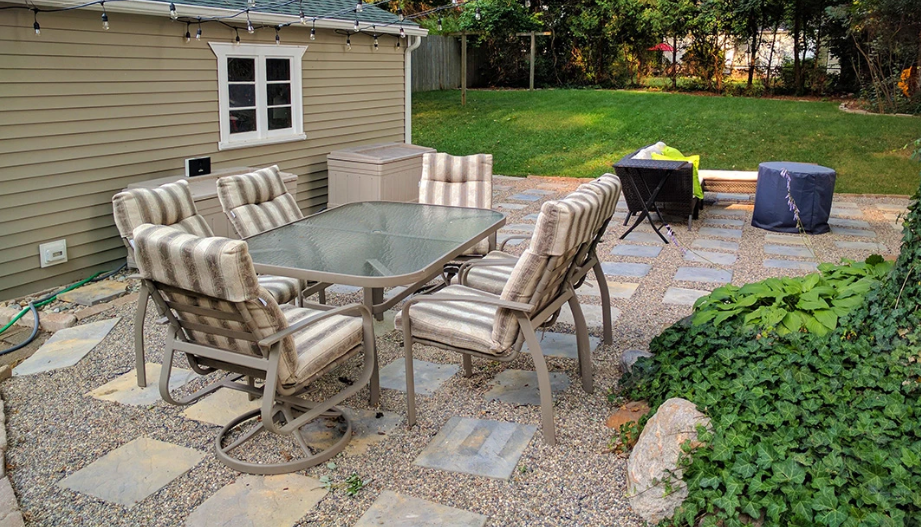
TRUEGRID systems are largely self-cleaning in rain and need no sealing. Because no grout or mortar exists, weeds rarely appear. Should settling occur, lift and re-compact the base, no demolition required. The modular format allows updates as landscaping evolves, matching the adaptive mindset behind all modern patio ideas.
Routine Maintenance Checklist
- Remove leaves or organic debris before it decomposes.
- Inspect infill depth annually and top off if needed
- Irrigate, fertilize, and mow grasses, as needed, if used. Do not aerate.
- Check edge restraints and anchor points for movement.
- Confirm drainage remains unobstructed after major storms.
With proper upkeep, these systems preserve the structure and style central to all modern patio ideas, ensuring form and function remain aligned for years to come.
Design a Modern Patio with TRUEGRID Permeable Pavers
TRUEGRID pavers unite architectural clarity with dependable drainage. Each interlocking grid supports gravel or grass infill to achieve modern design language while reducing runoff and heat gain. Contact our team today for design support and installation specifications.
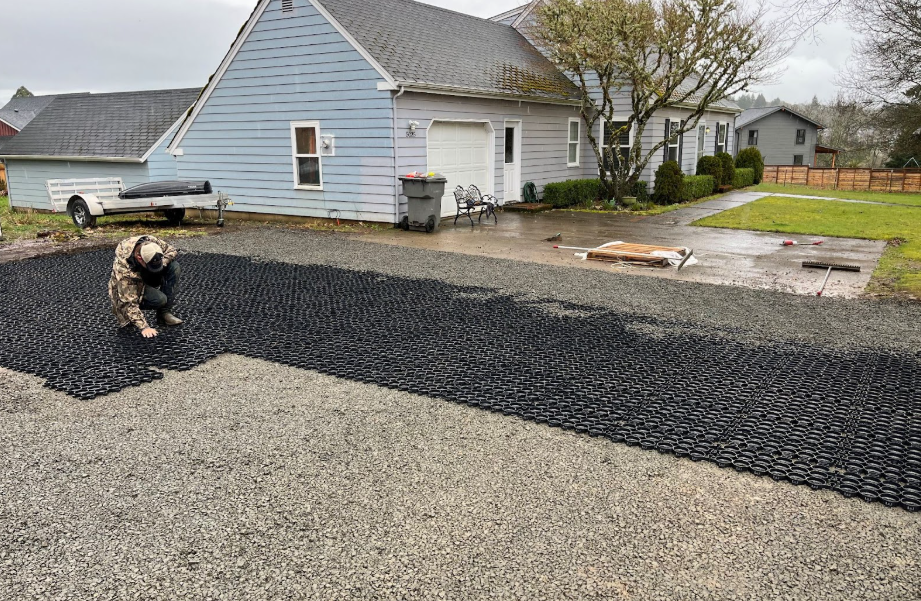
Every driveway starts with a plan. The materials, labor, and upkeep add up fast, so homeowners look for budget driveway ideas that save money without constant fixes. The surface you choose sets long-term durability, drainage behavior, and how often you’ll be out there raking after storms.
Affordable Materials for Budget Driveway Ideas
Budget driveway ideas usually center on loose or recycled materials that balance price and performance. Gravel is the go-to, but recycled asphalt, crushed concrete, and reinforced turf each offer practical, low-cost approaches when they’re detailed correctly.
Gravel Driveways
For most DIY projects, gravel costs about $2 to $5 per square foot for materials and base rock combined. Crushed limestone and decomposed granite drain well and look natural, but if the base is thin or poorly compacted, stone migrates under turning tires. Common maintenance includes raking displaced gravel, filling low spots, and ordering the occasional top-off delivery.
Recycled Asphalt (Millings) and Crushed Concrete
Recycled asphalt costs a bit more up front (~$3–$6 per sq ft DIY), but it compacts tightly and resists washout. Crushed concrete is similar in price and strength with a lighter, rougher texture. Both need a firm, graded base and edge restraint to keep surfaces tidy after rain.
Grass and Reinforced Turf
Turf or grass driveways blend into landscaping and can work where homeowners want a green look. In shaded or high-traffic areas, simple soil bases rut quickly, use load-spreading grids to keep wheels from sinking and to preserve permeability.
Site & Climate Factors That Affect Cost
Before comparing budget driveway ideas, match the material to your conditions:
- Freeze–thaw: Repeated cycles create soft spots under vehicles. Gravel and recycled aggregates tolerate movement better than thin concrete patches; any option improves dramatically with a compacted base and good drainage.
- Slope: Steeper grades push loose stone downhill. Plan for edging, cross-slope breaks, and containment grids where grades exceed ≈ 5 %.
- Soils: Clay holds water and pumps fines upward; sandy soils drain but can shift. Increase base thickness on clay, and use a geotextile separator to keep fines out of the base.
- Runoff & codes: Many towns encourage permeable surfaces; stabilized permeable systems help meet stormwater requirements and reduce erosion along drive edges.
Upfront Price vs. Lifetime Cost
Gravel and recycled aggregates are the lowest first-cost ways to build a driveway. The tradeoff is maintenance: periodic light regrading and stone top-offs to keep edges clean. Poured concrete and new asphalt reduce that maintenance but raise initial spending far beyond most budget driveway ideas.
A middle route, stabilizing the surface with permeable grids, keeps costs low while controlling erosion and stone migration. That’s where structural stabilization comes in.
How TRUEGRID Permeable Pavers Lower Driveway Costs
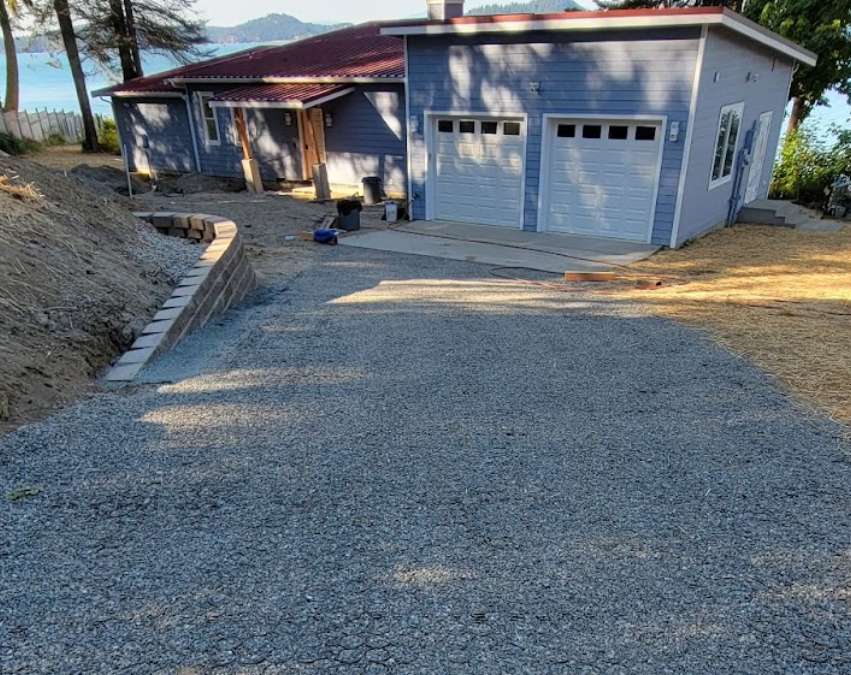
TRUEGRID pavers interlock to hold gravel or turf in place. The recycled-plastic cells distribute vehicle loads evenly, prevent ruts, and let rainwater drain through the surface instead of running off into landscaping.
Installation (DIY-friendly
- Excavation depth is typically 7 in. for passenger cars (deeper for heavier loads).
- Place geotextile (as needed) and compact base rock in thin lifts.
- Snap TRUEGRID panels together by hand and cut to fit edges.
- Fill with gravel (or soil for turf) and compact.
- Once filled, the driveway takes traffic immediately, no curing delays or special equipment.
Maintenance & durability
Because the grid contains the aggregate, you’re not raking gravel back after every storm. The recycled plastic resists UV and freeze–thaw; turning tires won’t kick stone aside or form potholes. Years later, you might add a light top-off for appearance, but the base stays intact.
Lifecycle value
Upfront, the grid adds about $2–$4 per sq ft to a basic gravel build, but it eliminates recurring regrade costs, limits edge washout, and preserves drainage. Over a few seasons, especially on slopes or clay soils, that stability offsets the small premium and keeps the surface looking clean.
Typical base sections, fill-stone choices, and edging methods for DIY gravel driveway ideas keep the surface stable and permeable.
Design Tips for Small or DIY Driveways on a Budget
- Check for re-use of existing gravel drives: In some cases, existing gravel driveways can be repurposed as a base layer for the new TRUEGRID layer. Please consult with experts (engineers or other professionals) for repurposing viability.
- Excavate first, then compact: Dig out the existing soils and compact the area
- Edge restraint: Use steel edging, flush concrete bands, or anchored timber to delineate the permeable pavers from the adjacent areas. Edging is needed for raised (above grade) installations but can be used for at-grade installs for aesthetics.
- Separator fabric: Place a non-woven geotextile between the subgrade and up the sides of the excavated area to prevent fines from pumping into the rock.
- Base Layer: Place and compact – in lifts – the desired base layer. High void drainage rock (¾” to 1.5”, depending on the product) can be used for optimal water storage and infiltration. Compactable bases can be used for other applications – consultation with an expert is recommended.
- Infill stone choice: For the wear layer, select angular stone (½”, ⅝”,or ¾” – depending on product) that interlocks; rounded pea gravel tends to wander. Choose from stone colors that will enhance the landscaping and home.
- Tools most homeowners already have: Rake, tamper or plate compactor (rental), hand saw for trimming grid panels, string line, shovel, and level.
- Phased installs: TRUEGRID’s modular panels make it easy to build weekend sections—a lane first, then the full pad—without heavy equipment.
These details may sound minor, but they determine how well the driveway holds up over time.
Drainage, Erosion Control, and Sustainability
Permeable driveways reduce puddles, keep water on site, and protect the base from softening. Stabilized gravel within TRUEGRID limits edge erosion and supports groundwater recharge. The recycled-plastic grid keeps waste out of landfills while extending the life of the driveway, lowering both maintenance and landscaping costs over time.
Reduce Cost and Maintenance with TRUEGRID Permeable Driveways
TRUEGRID pavers create strong, permeable surfaces that stay level through rain and daily traffic. Each grid stabilizes gravel or grass fill to prevent ruts, erosion, and drainage problems. The result is a low-cost driveway that looks clean and performs long-term. Contact us today for more information.
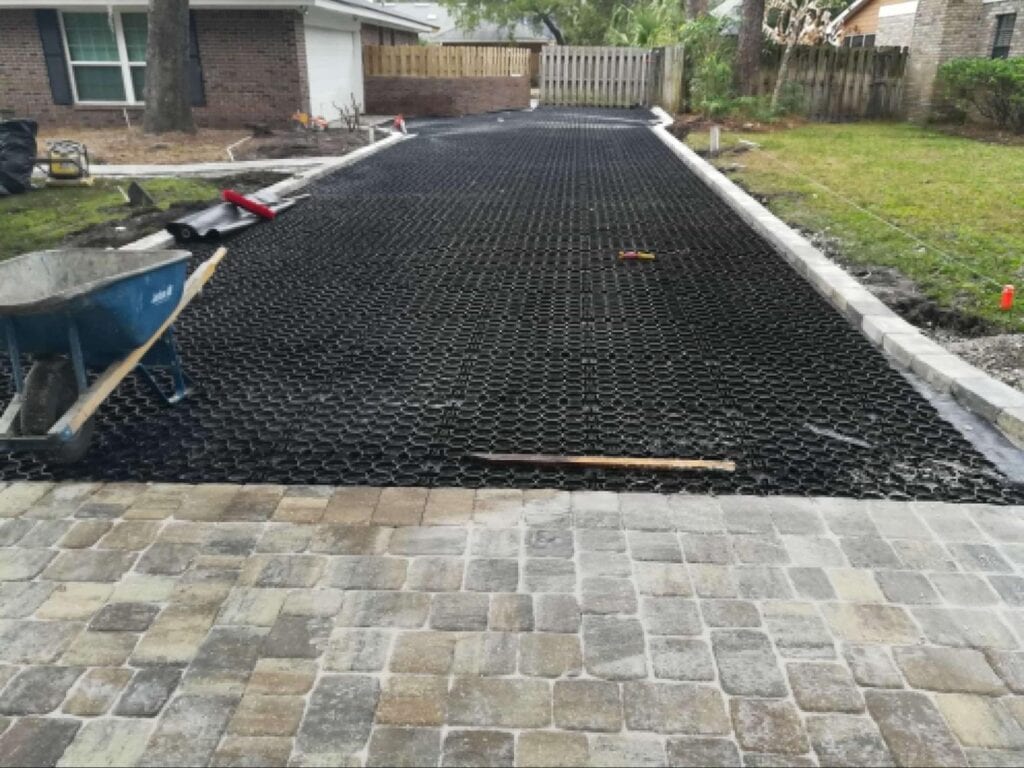
Every outdoor surface needs to drain, support weight, and last through weather cycles. A proper permeable paver installation manages all three by combining strength with open-cell design that filters water directly through the surface. TRUEGRID systems make the process straightforward for both homeowners and contractors, the way a well-planned job should be.
Why Permeable Paving Matters
Permeable paving isn’t just a construction trend, it’s an environmentally responsible solution that improves drainage, minimizes stormwater runoff, and reduces erosion. Instead of forcing water across a hard surface and into storm drains, permeable systems allow rainfall to filter downward through aggregate layers and back into the soil.
This natural infiltration helps:
- Recharge groundwater
- Reduce flooding risk
- Filter pollutants before they reach waterways
- Support long-term landscape health
Because these systems handle both load and drainage, they work well for driveways, walkways, patios, parking areas, and more, all while maintaining a clean, stable surface that lasts for decades.
Before You Begin: Tools, Materials & Resources
Before you start your permeable paving project, it’s important to gather the right tools and materials. Having everything ready will make the installation go smoothly and help your driveway or patio last for years.
Permeable Pavers
Choose the type of TRUEGRID pavers that best fits your project. PRO LITE works well for lighter residential use, while PRO PLUS is better for heavier loads or vehicles and on sloped driveways..
Aggregates (Gravel Layers)
You typically need two types of gravel for a proper install:
- Coarse gravel (sharp drain rock) for most base layers or, compactable gravel as the base layer on slopes and when high amounts of drainage is not needed
- Stone infill for filling the pavers and adding your desired look
Geotextile Fabric
This fabric sits between the soil and the base gravel to keep the layers from mixing. It helps your system stay stable and drain properly over time.
Edge Restraints
These keep the pavers in place and help the finished area maintain its shape..
Basic Tools
Gather simple tools like a shovel, rake, rubber mallet, level, and a string line. You’ll also need a compactor to prepare the soil and gravel layers. You may want to consider renting mechanical and power equipment (like small excavators) for larger projects.
Helpful Resources
Use installation guides, the TRUEGRID Calculator Tool, and your local city or county guidelines to make sure you’re meeting any requirements. If you’re unsure about any step, talking with a professional can give you extra confidence before you begin.
How Permeable Pavers Work and What to Know Before Installation
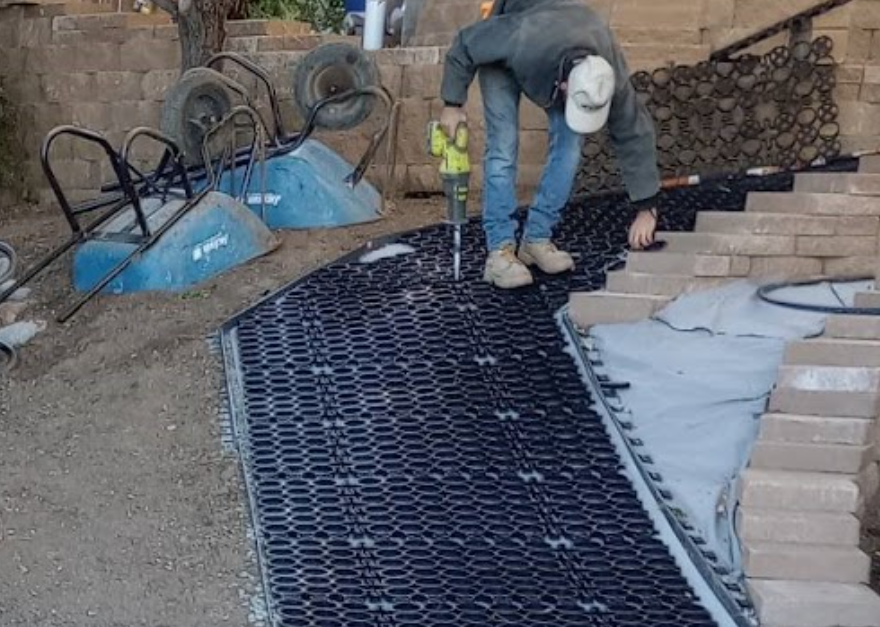
Permeable pavers create a stable surface that still allows rainwater to pass through. Instead of sending runoff toward drains, the grid and base layers filter water into the soil below, recharging groundwater and reducing erosion. Each layer serves a purpose: the surface grid spreads weight, the sub-base stores water and supports, and the soil absorbs and releases it gradually.
When designed and installed correctly, the system lasts for decades, reducing maintenance costs and stormwater impact while keeping driveways, patios, and walkways firm underfoot.
Step 1: Plan Your Permeable Paver Installation
Every installation starts with the site. Check grades, utilities, and intended use, whether a walkway, patio, or full vehicle driveway. Note the position of the permeable system to building foundations and other areas where you may not want water to flow. Use grading techniques and check for waterproofing on foundations, add when needed.
Loam or sand requires less excavation than heavy clay, but all projects need stable subgrade before gravel placement. Mark boundaries, measure square footage, and estimate materials using the TRUEGRID Calculator Tool to simplify ordering and cost planning. A well-planned permeable paver installation saves rework later and improves long-term drainage efficiency.
Step 2: Excavate and Prepare the Base
Excavation depths vary depending on soil and expected loads. Walkways or patios often require 0-5 inches, while driveways and parking areas may need 5-10 inches for structural strength. Of course, your soil type and project may vary and need more base. Strip away topsoil and organic matter first, then compact the subgrade until it won’t budge underfoot.
A geotextile fabric separates native soil from the base stone, preventing fine migration that leads to settlement. During installation, this separation is key, it preserves infiltration and keeps layers stable under repeated loading.
Step 3: Install the Base Layer
Once excavation is complete and the fabric is placed, spread coarse (¾” to 1.5”, depending on the product used) crushed stone for the structural base. Compact in lifts no thicker than 4 inches for uniform density. Please consult with a design expert for other base composition uses, such as a compactable base.
Step 4: Place TRUEGRID PRO LITE or PRO PLUS Pavers
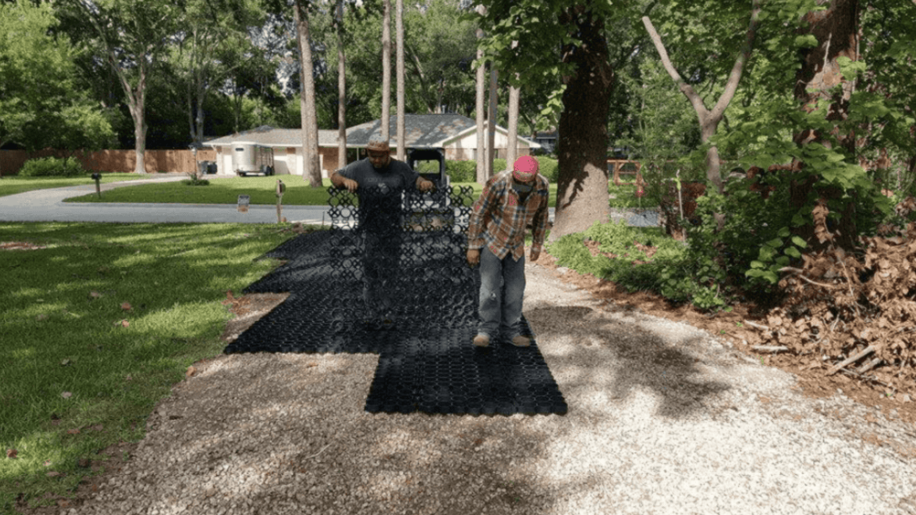
With the base compacted and leveled, it’s time to install the paver grids that give the system its strength. Both TRUEGRID PRO LITE and PRO PLUS assemble the same way, but each is engineered for a specific load range.
Installing TRUEGRID PRO LITE
Start along a straight edge or snapped string line, just like setting tile, to keep rows true.
TRUEGRID PRO LITE panels may arrive pre-connected in two-by-two-foot sections that snap together quickly without specialized tools. Each unit locks into its neighbor with built-in tabs, forming a continuous grid that distributes load evenly for light-duty applications such as residential driveways.
Installing TRUEGRID PRO PLUS
For heavier loading and on sloped driveways, TRUEGRID PRO PLUS provides the added strength and axle-load capacity needed for long-term commercial performance. Panels connect using the same interlocking tabs and can be cut with a circular or reciprocating saw where curves or borders require precise fit.
Note: Staking or anchoring the TRUEGRID is recommended when sloped projects exceed a certain percentage. Please consult with TRUEGIRD or a design expert.
Step 5: Fill the Cells and Finish the Edges
After the grid is in place, fill each cell with angular aggregate such as ⅝-inch clean stone. Rounded gravel tends to roll, while crushed rock interlocks under pressure. Clean, angular stone should be self-aligning and fill level to the top of the grid. Compaction with a plate compactor or rolling compactor is optional and generally not needed.
Add edge restraints, metal, plastic, or concrete, to prevent lateral movement. These details protect the geometry of every installation, keeping the surface aligned through freeze-thaw and vehicle turning forces. Once the fill settles, step back and check slope and uniformity before final compaction.
Step 6: Check Drainage and Perform Maintenance
Unlike concrete or asphalt, a permeable paver surface eliminates standing water by channeling rainfall directly through the base layer. The clean aggregate provides temporary storage and slow release into the subsoil, reducing runoff, flooding, and erosion.
This structure also filters pollutants, oils, sediments, and heavy metals, before they reach groundwater.
Periodic maintenance is simple: remove surface debris. Although rare, you may need to inspect low infill spots and add more stone. Also rare, check and treat for weeds or undesired vegetation – environmentally friendly removal is recommended.
Where local codes require verification, follow ASTM C1781 testing procedures to confirm infiltration performance over time. With routine care, TRUEGRID systems perform for decades without cracking or ponding.
Step 7: Review and Compact the Final Surface
Before wrapping up, verify slope and edge integrity. Walk the surface and confirm that no panels have shifted and all stone sits level with the grid.
This final step locks the aggregate into place, ensuring your permeable paver installation supports traffic immediately while maintaining full drainage capacity.
DIY Tips for Installing Permeable Pavers
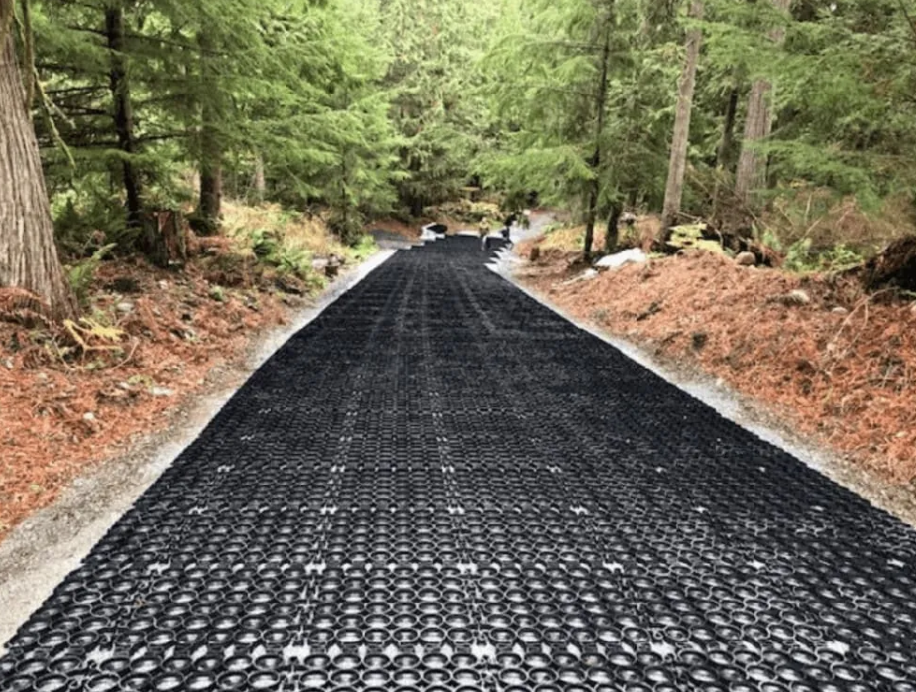
Many homeowners tackle installing permeable pavers themselves over a weekend. The key is steady compaction and accurate alignment. Work in manageable sections, keep panels square, and check slope periodically. A hand tamper works for small patios; larger driveways benefit from a rented plate or rolling compactor.
Use clean, washed aggregate, no fines or sand, to preserve infiltration. Always verify slope with a straightedge and level. Following the same sequence used by professionals ensures that DIY permeable paver installation projects achieve the same durability and drainage performance.
Comparing Permeable and Traditional Paving
A short comparison helps clarify value. Asphalt and concrete shed water into storm drains, increasing runoff and heat retention. Gravel alone migrates and ruts without confinement and will need repeated gravel surface placement over time.
A modern gravel grid installation using TRUEGRID combines the permeability of gravel with the stability of pavement. The grid’s open-cell structure holds aggregate in place while maintaining natural infiltration, meeting stormwater codes and reducing long-term maintenance costs. Professional permeable paver installation delivers the same stable finish as traditional paving, without the runoff problems.
Finish Your Project with TRUEGRID Permeable Pavers That Perform
TRUEGRID provides design and planning support for every project size. The product line and resources make installation predictable, strong, and environmentally sound from start to finish. Both PRO LITE and PRO PLUS systems deliver long-term strength with full infiltration and minimal upkeep. Contact us today for more information.
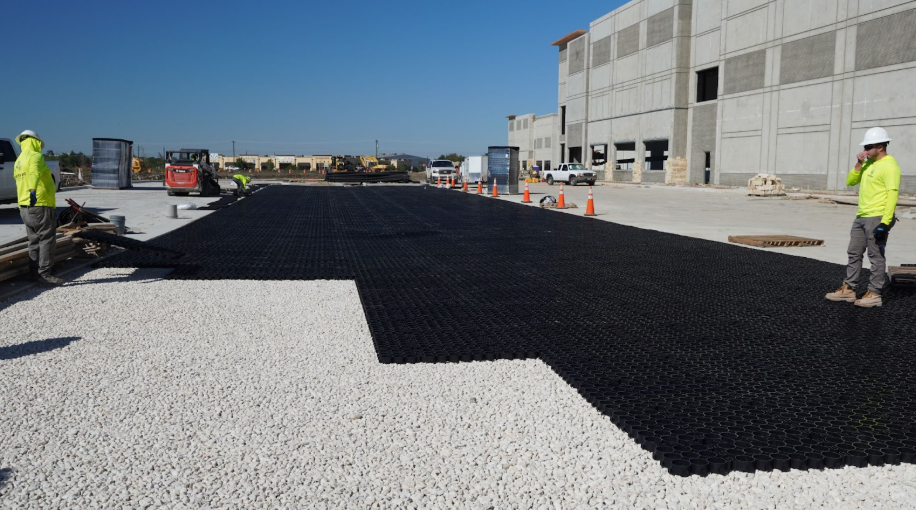
Water decides how every pavement performs. When rain can’t drain through the surface, it collects at the edges or underneath, building pressure that cracks concrete and erodes soil. The choice between permeable pavers vs non-permeable pavers determines whether that runoff escapes safely or undermines the pavement over time.
What Is the Difference Between Permeable and Non-Permeable Pavers?
A permeable system lets rainwater flow through its surface and base layers. Open cells or spaced joints route water into a graded aggregate bed that stores and filters it before release into the soil. That underground layer acts like a small reservoir, preventing erosion,protecting foundations by keeping runoff in place, and releasing the water back into the ground water supply.
An impermeable surface, solid concrete, asphalt, or tight brick, blocks infiltration completely. Instead of soaking through, water must be diverted through slopes or drains. That physical contrast defines what is the difference between permeable and impermeable paving: one manages stormwater on-site, the other sends it away.
How TRUEGRID Permeable Pavers Work
Each TRUEGRID system manages water and weight at the same time, combining structural engineering with natural drainage. The result is a pavement design that filters runoff while staying firm under heavy use.
Engineered for Strength and Infiltration
TRUEGRID’s permeable pavers take the same drainage principles and refine them for long-term strength. Each interlocking grid, molded from recycled polymer, locks angular gravel into place to form a rigid, permeable surface. Rainwater moves vertically through the cells into a compacted stone base, where it’s filtered before slowly recharging the soil.
Load Distribution and Surface Stability
Unlike standard permeable blocks or open-joint pavers, TRUEGRID distributes loads through a continuous grid system that minimizes rutting and surface movement. When comparing permeable pavers vs non-permeable pavers, that uniform load transfer is what keeps driveways, parking areas, and fire lanes firm even under heavy traffic. Conventional slabs rely on slope and thickness alone, and once they crack, the system fails. That performance difference becomes most visible when you see how each surface handles rain in motion.
Drainage and Flood Control
Drainage defines the gap between permeable pavers vs non-permeable pavers. Permeable surfaces drain rapidly, over 1000 inches per hour, preventing puddles even in downpours. They recharge groundwater, stabilize soil moisture, and stop washout along edges. Non-permeable pavements rely on gutters and catch basins that can clog or overflow, causing flash-flooding that permeable designs help prevent.
Climate and Soil Compatibility

Permeable paving handles nearly any climate. In warm, wet regions it keeps surfaces dry and mold-free. In cold zones, the open base frequently drains meltwater before it can refreeze, reducing heave and surface damage. On clay soils, the graded stone under TRUEGRID acts as a stabilizing buffer, limiting movement that cracks rigid pavement. Proper base depth is adjusted for local frost lines and infiltration rates.
Installation and Cost
When cost and build time are compared between permeable pavers vs non-permeable pavers, the contrast comes down to purpose. Non-permeable pavements install as a solid surface that simply sheds water away. A permeable system is designed to do more, it builds drainage directly into the base so the finished surface manages runoff on its own.
Crews excavate only as deep as needed for structural support and water capacity, then compact the sub-soil, add aggregate, set the grid panels, and fill with gravel or turf. No curing. No sealing. Just strength and built-in drainage.
Installation, Accessories, and Long-Term Performance
TRUEGRID systems also install with delineation markers, and sometimes anchors, that lock panels in place and provide layout precision for high-traffic or sloped applications. These small details ensure long-term alignment and maintain uniform drainage over time.
- For most driveways, installation finishes in a single day.
- Typical installed cost estimates for TRUEGRID systems range from about $8–$11 per sq ft, depending on base depth and fill.
- Concrete runs $10–$15 once formwork and drainage hardware are included.
- Although asphalt will most likely initially cost less than TRUEGRID, periodic sealing, resurfacing, and replacement cost make upkeep potentially expensive.
- Over 25 years, permeable assemblies usually cost less while performing longer.
These installation details support the long-term stability that defines how the system performs once traffic and weather start testing it.
Maintenance and Durability
TRUEGRID panels take whatever you park on them, from sedans to semis, with ease. The locked gravel flexes with ground movement, preventing surface fractures. Removing organic debris such as leaves prevents issues. Vary rarely, you many need to remove weeds and add some infill gravel to isolated areas. For grass permeable paver systems, regular watering, fertilizing, and mowing are typical. Aeration should not be done
Non-permeable slabs need seal coats and crack repair. Once water enters, freeze-thaw cycles widen gaps and increases problems. Water and temperature shifts can also crack impermeable surfaces from underneath and from tire pressure over time leading to full replacement of the surface. TRUEGRID’s PRO PLUS polymer grid stays stable from −58 °F to 180 °F, even under heavy commercial vehicle loads, and are engineered for long-term durability and rut-resistant performance.
Environmental Performance
Permeable pavements mimic natural hydrology by filtering pollutants and returning clean water to the ground.
- Infiltration and detention in the systems can eliminate polluted water runoff.
- They greatly reduce runoff volume and speed, reducing downstream water temperatures and therefore are less harmful to aquatic life.
- TRUEGRID products use 100 percent recycled HDPE and require no sealants.
- Organic and non-organic pollutants are removed from stormwater preventing contamination downstream.
- Their light color reflects sunlight, keeping the surface cooler.
Environmental comparisons of permeable pavers vs non-permeable pavers show clear sustainability benefits. Solid, impermeable surfaces push polluted water into drains, trap heat, and take more energy to produce. Permeable systems do the opposite, filtering runoff, cooling the surface, and helping neighborhoods stay cleaner and more resilient after heavy rain.
Design Flexibility and Aesthetics
TRUEGRID’s modular pavers cut easily to follow curves or property lines. Fill options range from gravel for modern driveways to turf for green parking. This flexibility keeps infiltration performance intact. Non-permeable slabs restrict design freedom because every grade change or patch weakens the surface.
Real-World Applications

You can spot the difference after the first storm.
- Homeowners install permeable driveways to eliminate puddles.
- Landscapers specify grids for patios and walkways that stay level through rain and freeze cycles.
- Municipal projects use TRUEGRID for parking lots, fire lanes, and access roads that must meet stormwater management requirements.
- Engineers and developers can eliminate detention ponds, underground drainage, and filtering and water conveyance equipment.
Non-permeable options still work for interiors or drainage-controlled zones, but they offer no infiltration benefit. These examples show how infiltration directly reduces long-term maintenance needs and extends pavement life.
Lifecycle and Regulatory Advantages
Over decades, the performance gap widens between permeable pavers vs non-permeable pavers. TRUEGRID installations maintain full permeability and strength with minimal upkeep. Rigid pavements decline once small cracks appear and through use. Because permeable systems qualify for LEED and local stormwater credits, they streamline permits and reduce fees. Numerous municipalities and water districts now encourage or require permeable pavement in new developments, making early adoption both practical and compliant. Some agencies even offer tax benefits or stormwater credits for changing out impermeable surfaces to permeable ones.
Choose TRUEGRID Permeable Pavers for Durable Drainage Performance
TRUEGRID permeable pavers combine recycled materials with long-term structural strength. Each grid distributes load evenly, allowing continuous infiltration and eliminating runoff. The result is a pavement that stays level, drains quickly, and remains resilient through years of weather exposure without cracking or surface erosion. Contact us today for more information.
