Water must drain properly for a gravel driveway to stay stable. Without drainage, gravel shifts, compacts, and breaks down over time. Effective gravel driveway drainage solutions prevent structural damage and surface failure by controlling both runoff and ground absorption.
Why Drainage Fails in Gravel Driveways
Most gravel driveways begin with clean edges and a compacted surface, but performance depends on more than just the top layer. Graded gravel – typically used on gravel drives – is practically impermeable if the composition isn’t near perfect.
Common Signs of Gravel Driveway Drainage Failure
- Rainwater quickly reveals poor grading or base prep.
- Puddles form in low spots, gravel begins to shift, and rutting takes hold.
These early warning signs indicate drainage failure—and if left unchecked, they accelerate surface erosion and long-term wear.
- Runoff that isn’t diverted or absorbed can saturate the base layer, which undermines stability.
- Fine particles migrate, forming soft spots under load.
- The result is a surface that sinks in places, bulges in others, and requires frequent top-offs or regrading.
Many of these failures are preventable with properly engineered gravel driveway drainage solutions that address both surface and subsurface flow.
The Role of Crowning and Grading
Most driveways rely on a center crown to direct water toward the sides. A common rule of thumb is about 2 inches of elevation per 10 feet of width.
What Is a Proper Crown Slope for Gravel Driveways?
According to DOT and regional grading manuals, driveways should maintain a center crown with a 2% cross-slope—approximately 2.4 inches over 10 feet—to direct water away from tire paths and reduce rutting. Crowns should be rechecked seasonally and regraded as needed after heavy rainfall. Without this slope, water collects in the vehicle path, forming ruts that deepen with each storm.
Crowning only works when paired with a stable sub-base. If the underlying soil is loose, organic, or clay-heavy, even a properly crowned surface will deform. In these cases, drainage must be improved both below and around the surface layer.
Subsurface Gravel Driveway Drainage Systems
When crowning and surface grading aren’t enough, subsurface drainage methods like ditches and French drains help redirect water away from the driveway structure.
How Ditches and Trenches Handle Runoff
On rural sites or open lots, shallow ditches along both sides of the driveway help runoff disperse into surrounding soil. These channels handle high flow volumes and protect the driveway edge from erosion. They’re simple to maintain and work well when space allows.
Deeper trenches filled with gravel or lined with perforated pipe—often called French drains—intercept water along the length of the driveway and redirect it underground to a safe discharge point. French drains should be installed with a minimum slope of 1% (1 inch drop per 10 feet), with trench depths typically ranging from 18 to 24 inches depending on site conditions.
Recommended French Drain Dimensions and Design Tips
- The trench should be 6 to 12 inches wide and 18 to 24 inches deep, depending on runoff volume and site grading.
- Use clean, angular gravel (typically ¾″ or larger) to promote infiltration and prevent settling.
- A perforated pipe should be laid with the holes facing down to allow water collection while preserving structural support.
Once the system is in place, wrap the pipe and gravel with a geotextile fabric to prevent sediment clogging and maintain long-term performance.
Surface-Level Drainage Options
Some driveways require surface drainage strategies, especially in tight lots or where gravel meets structures. Channel drains are often the best solution for controlling runoff when space is limited.
Channel Drain Installation Tips for Tight Spaces
Channel drains are narrow trenches set at grade and covered with a grate. They tie into underground piping and are commonly placed at garage thresholds or driveway aprons—anywhere water has nowhere else to go. These systems work well in space-constrained areas but require precise installation to maintain continuous flow.
- Standard channel drains should be at least 4 inches wide and set on a concrete or stabilized base to prevent shifting.
- Most residential versions are rated to handle 0.5 to 1.0 inches of rainfall per hour.
Channel drains can also be paired with gravel driveway drainage solutions that stabilize the surface while allowing water to filter down rather than run off.
Why Soil Type and Sub-Base Construction Matter
Subsurface drainage depends on more than just gravel. Soil characteristics and the structure of the base layer determine how well water moves beneath the surface—and whether the driveway remains stable under load.
How Soil Type Affects Gravel Driveway Drainage
Sandy soils promote fast drainage and dry out quickly, helping maintain a stable sub-base. Clay soils retain water, slowing drainage and creating moisture buildup beneath the gravel. When water lingers in the base, it destabilizes the surface and increases the risk of rutting or washouts.
Best Practices for Sub-Base Construction
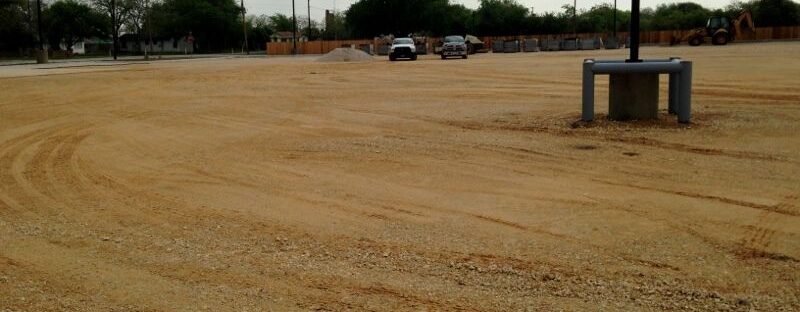
Driveways should include a 4–6 inch base of ¾″ angular stone, which offers both load-bearing strength and pore space for drainage. Avoid rounded gravel or fines-only blends, which compact poorly and restrict water flow. In soft soils, a geotextile fabric beneath the base prevents pumping and migration, keeping the structure intact across soil transitions.
Reinforced Systems That Lock Gravel in Place
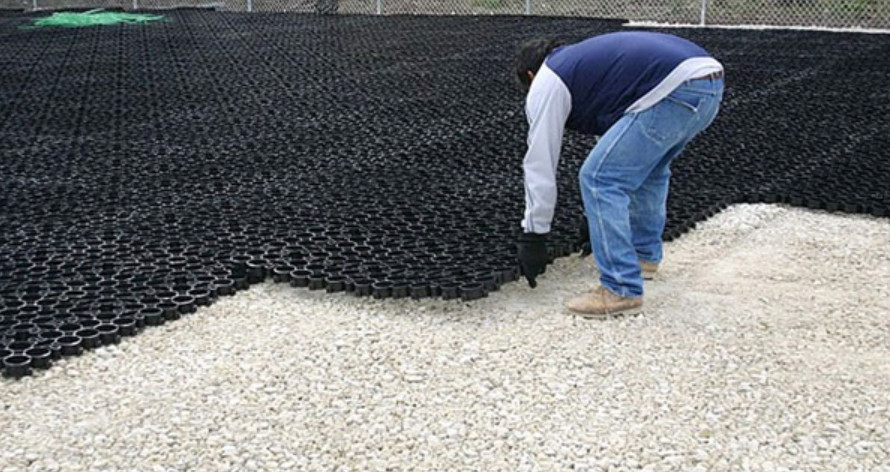
Loose gravel fails under repeated traffic. Vehicle tires push gravel to the edges, create depressions, and scatter surface stone into nearby grass or landscape beds. These effects are worse when drainage is poor. That’s where reinforced systems change the equation.
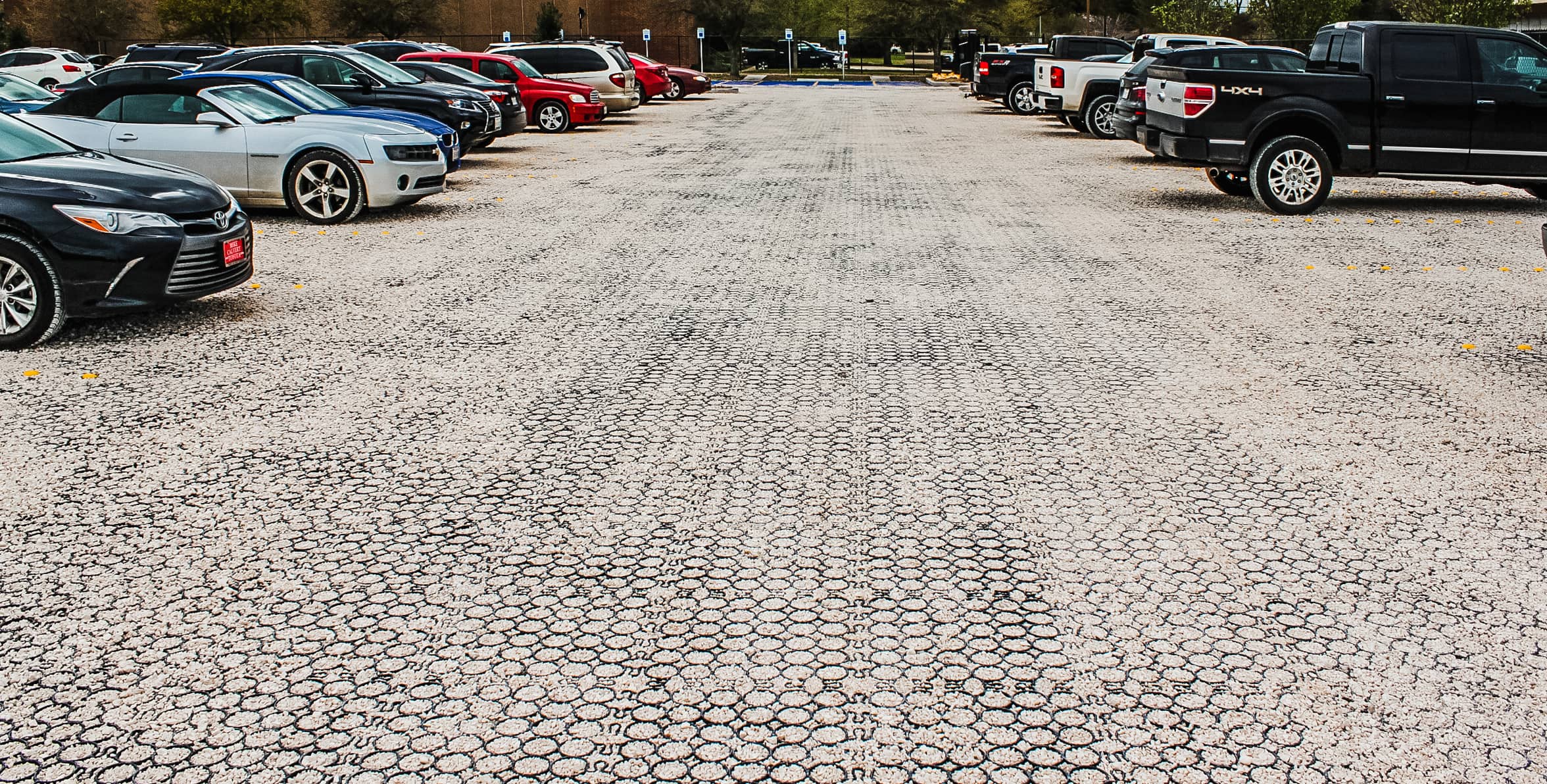
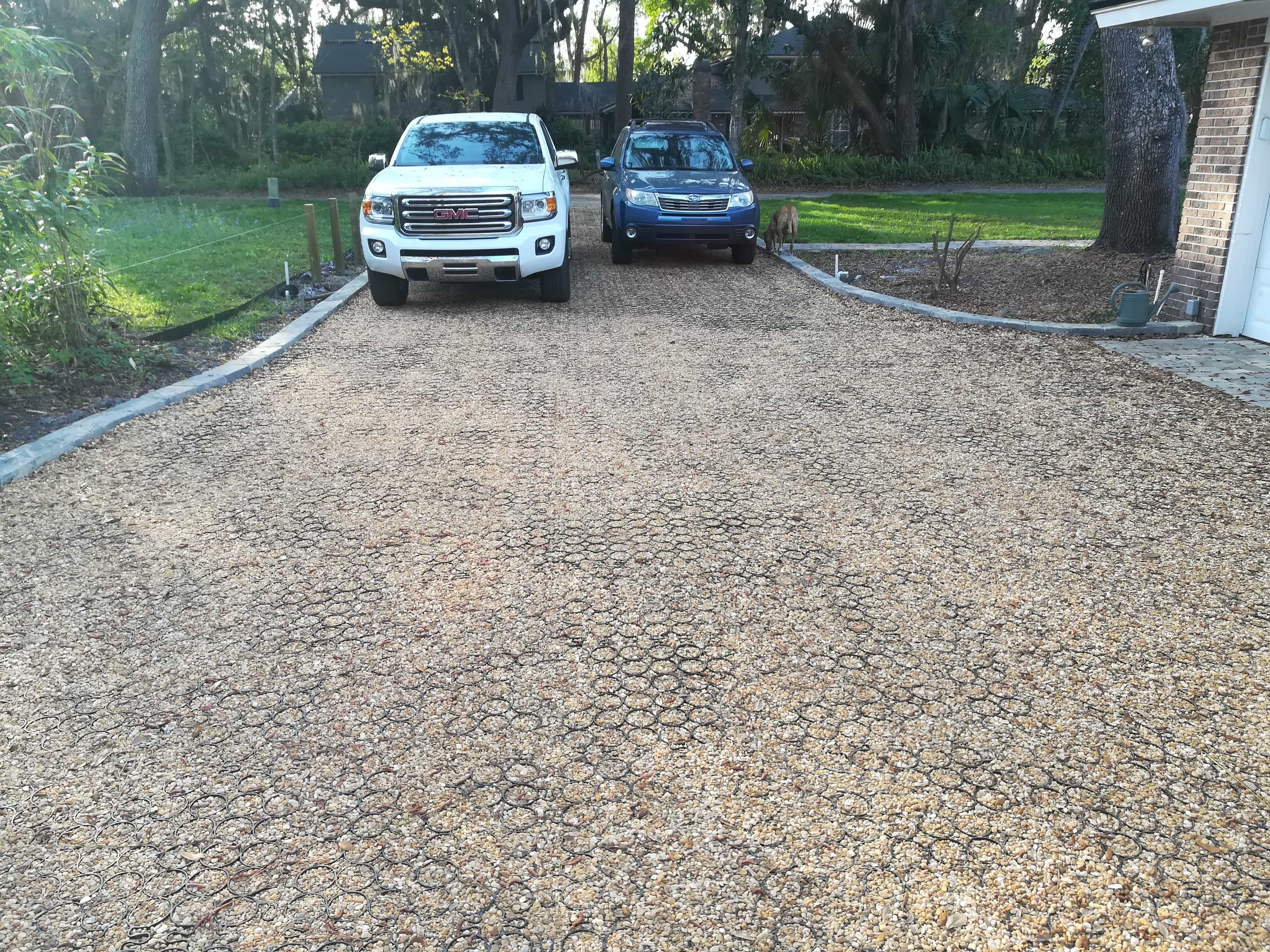
- Permeable grid systems contain the gravel within individual cells.
- These cells distribute weight, resist movement, and maintain surface evenness under real-world use.
- Gravel stays in place—no raking, no rutting, no washouts.
- Crowning, under-drains, and other engineering is not typically necessary with a grid paver
These engineered gravel driveway drainage solutions lock in surface gravel and eliminate the movement that leads to rutting and edge failure.
TRUEGRID Systems Eliminate Runoff and Rework
Each TRUEGRID system is designed to tackle specific jobsite challenges—such as managing surface runoff, preventing rutting under vehicle loads, and reclaiming space otherwise lost to drainage infrastructure.
PRO LITE: Fast Install, Long-Term Surface Control
TRUEGRID PRO LITE locks gravel into place and drains water directly through the surface—even in tight spaces or soft soils. It installs fast with no curing or sealing. Water moves into the sub-base, not across the surface, eliminating runoff that causes rutting and displacement. Each PRO LITE paver covers a nominal 4 square feet and installs at a rate of up to 500-1000 square feet per person per hour.
PRO PLUS: Strength for Heavy Loads and Daily Traffic
TRUEGRID PRO PLUS withstands repeated HS-20 axle loads without shifting, cracking, or displacement—backed by a compressive strength of over 17,000 psi when filled. It performs under daily use and controls water at the surface. Both systems reduce rework by eliminating the need for sealers, edging, or repeated gravel top-offs.
Recycled Plastic That Eliminates Runoff Infrastructure
Made from 100% recycled plastic, TRUEGRID systems remove the need for separate detention ponds on many sites. Grid-reinforced driveways help recover usable land and meet drainage goals without extra excavation. In many installs, permeable surfaces eliminate up to 21% of land typically set aside for detention.
These grid-reinforced systems are built for real jobsite conditions—supporting heavy use while controlling runoff through the surface.
Prevent Rutting, Displacement, and Washouts with TRUEGRID Gravel Drainage Systems
Design a gravel driveway that drains through the surface—not around it. Our systems stabilize the base, eliminate runoff, and resist rutting under real-world traffic. Contact us today for more information.